
Platform Overview

Repository intelligence for engineering leaders.

KodeGauge combines code analysis with infrastructure insight so you understand not just what's wrong, but why it matters and how much it costs.

Product Overview

A platform for code health that speaks your language.

Engineering teams have access to dozens of code scanners and quality tools. They tell you about bugs, complexity, and dependencies. But they rarely answer the questions engineering leaders actually need answered:

  • What's our real infrastructure footprint right now?
  • If we improve this, how much will it save us?
  • What's the critical path to fixing this problem?
  • Are we ready to scale? What's our bottleneck?

KodeGauge fills that gap. We scan your code and give you infrastructure-grade intelligence—the throughput capacity you have, the capacity you need, and the cost of the gap.

What you get from every scan

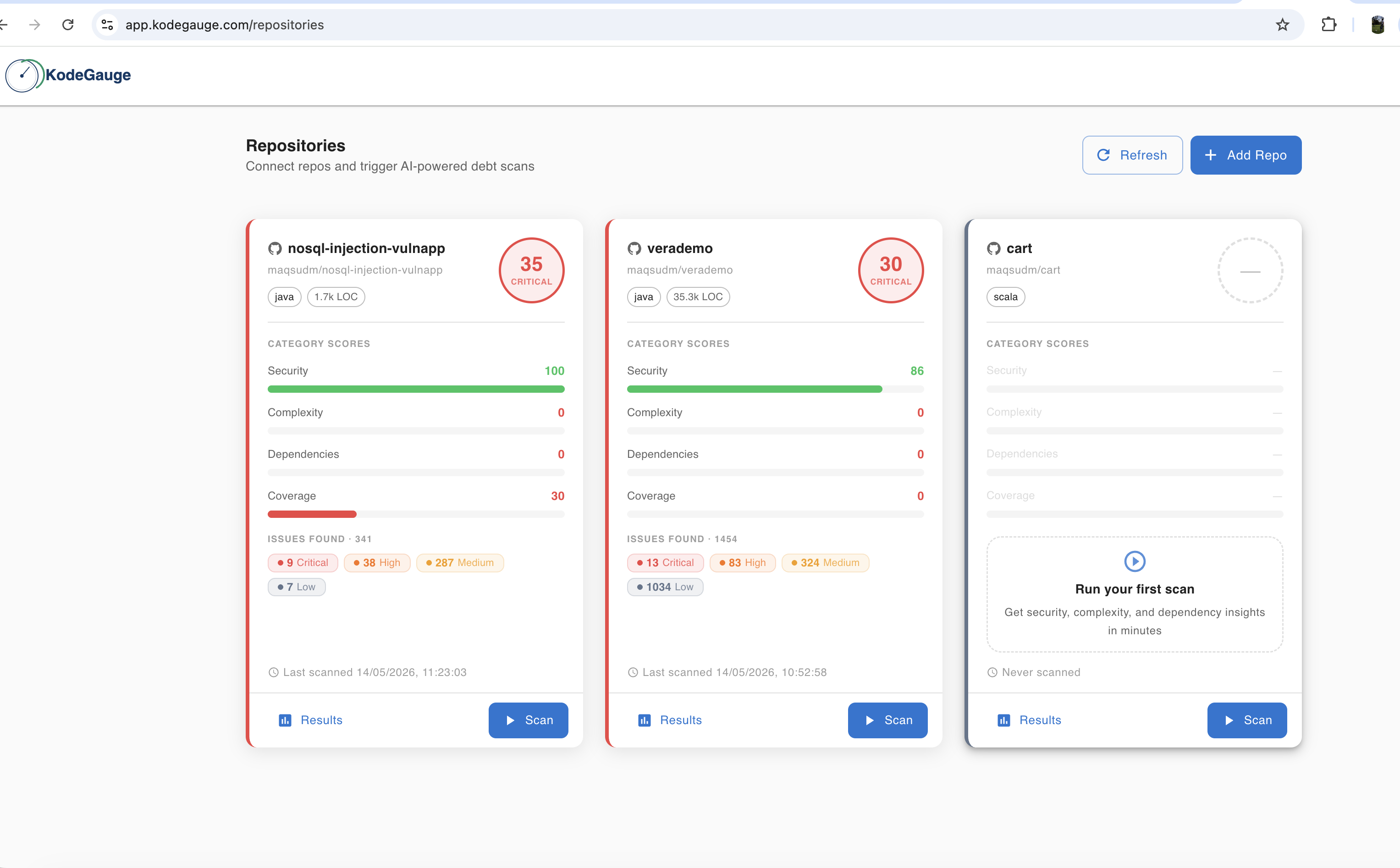
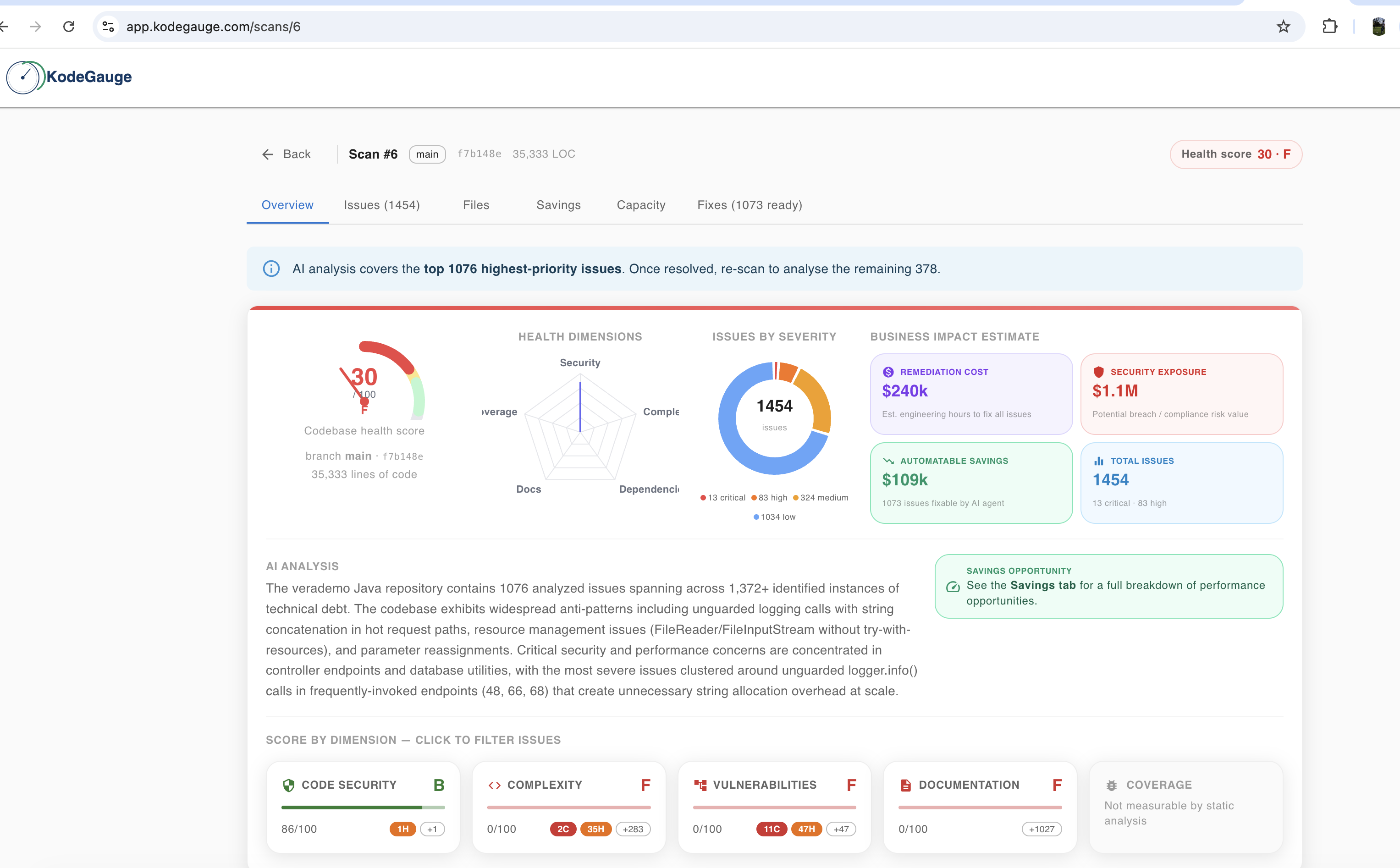
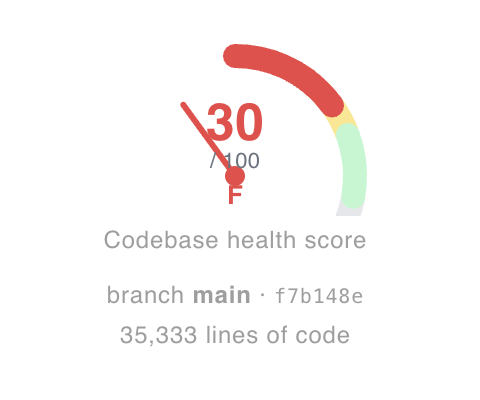
Repository health score

Across security, maintainability, performance, cost

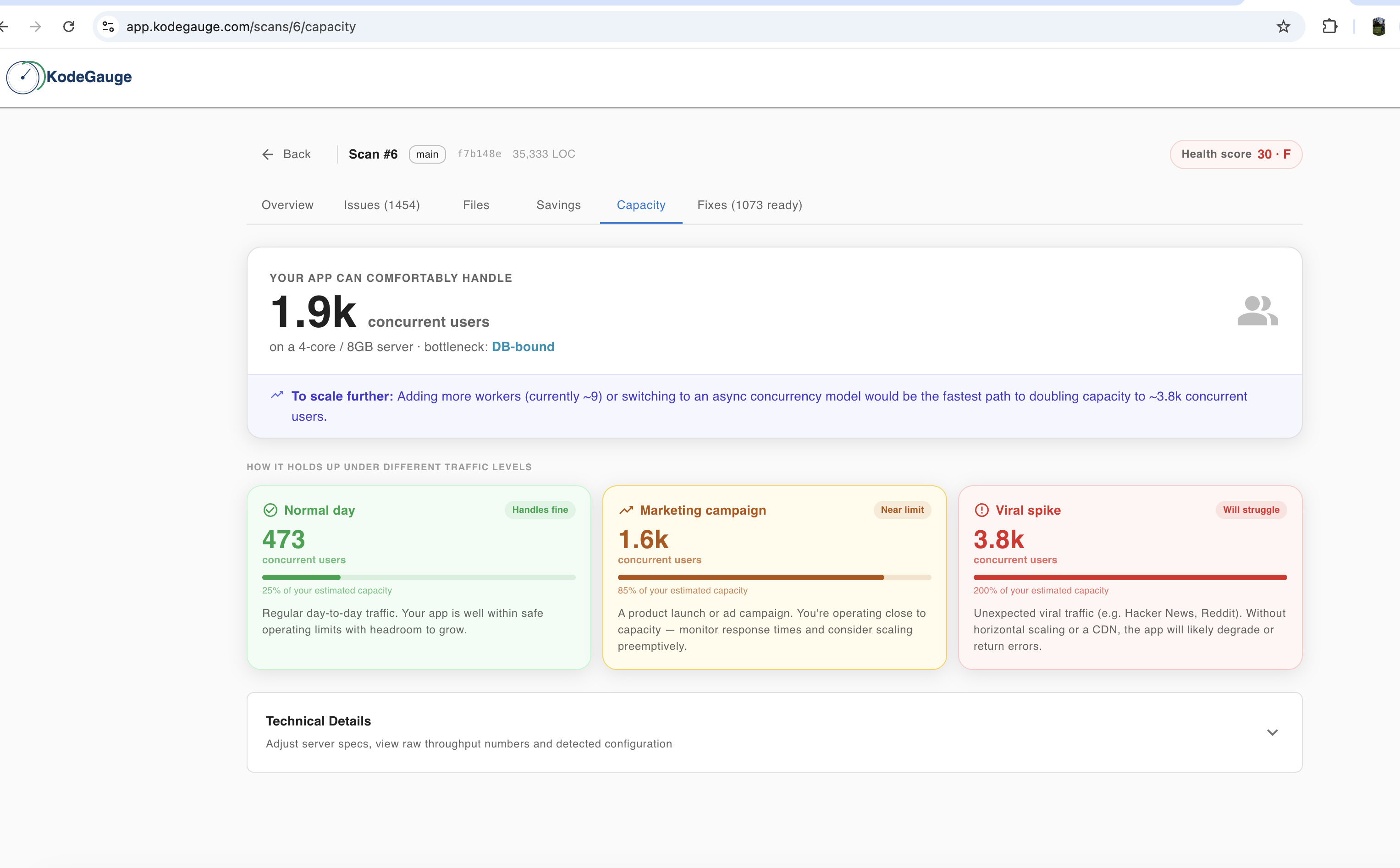
Infrastructure analysis

Concurrency, bottlenecks, throughput capacity

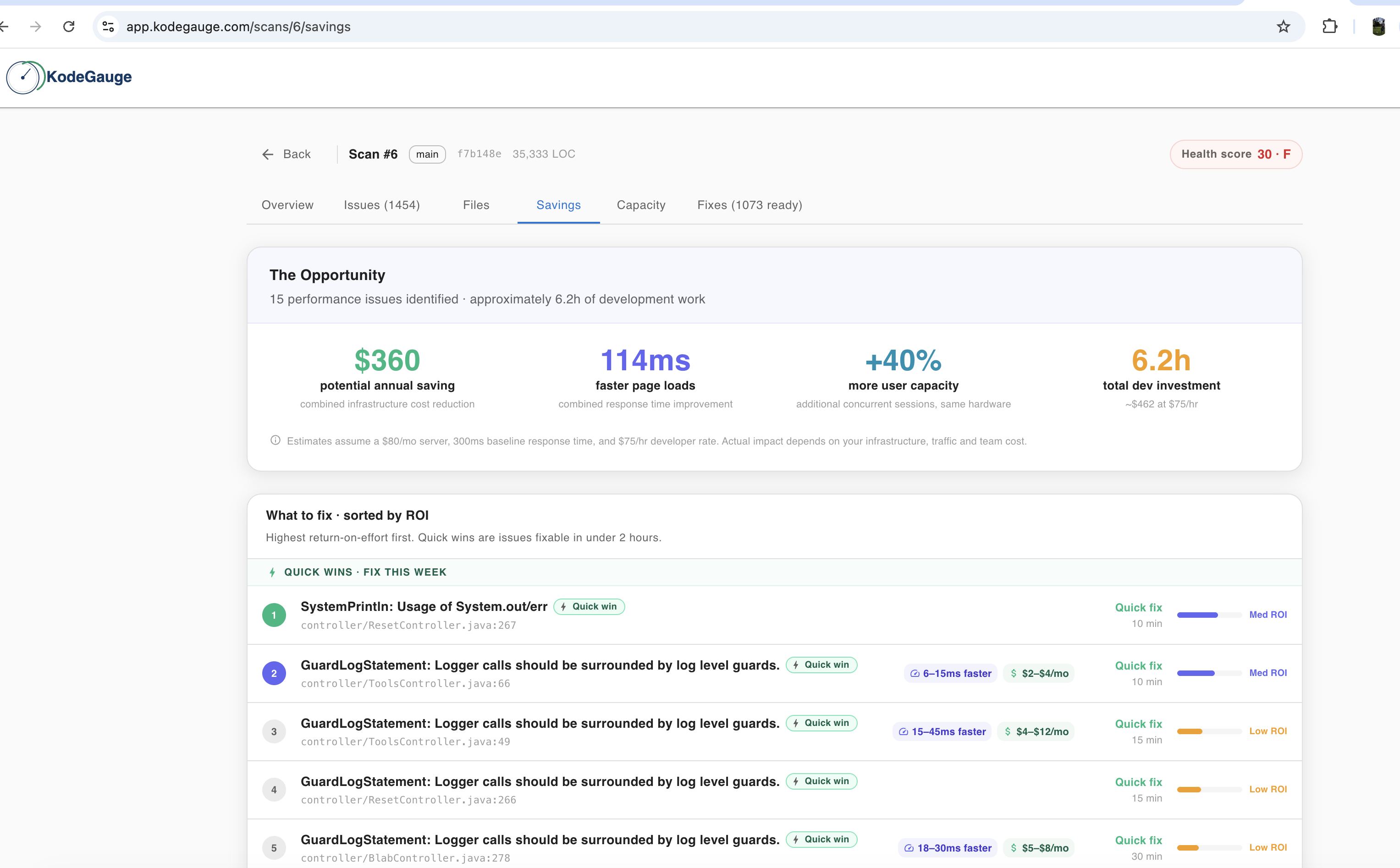
Cost estimation

Monthly/annual cloud spend and savings opportunities

AI prioritization

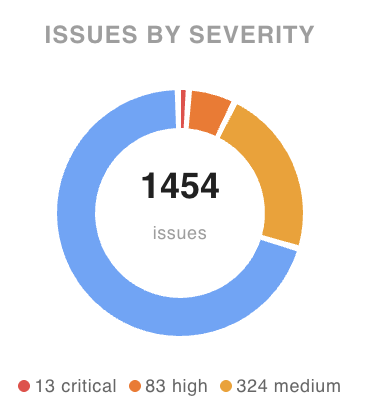
Ranked issues with effort estimates and business impact

Fix recommendations

Actionable guidance with implementation order

Core Capabilities

What you can do with KodeGauge.

Repository Health Scoring

  • Instant health score across multiple dimensions
  • Security, maintainability, performance, and cost efficiency ratings
  • Weighted scoring so you prioritize what matters most
  • Historical trending to measure improvement

Infrastructure Analysis

  • Detect concurrency models (async/await, threads, workers)
  • Identify primary bottlenecks (database, compute, memory)
  • Estimate database pool requirements and query patterns
  • Map cache layer presence and effectiveness

Cost Estimation

  • Model infrastructure needs with your current code
  • Estimate monthly/annual cloud spend
  • Calculate cost impact of optimizations
  • Show which improvements yield the highest ROI

Performance Insight

  • Estimate max sustained RPS with current resources
  • Show database throughput ceiling
  • Identify memory constraints
  • Provide scaling recommendations

AI-Powered Explanations

  • Plain-English summaries of complex findings
  • Understand why each issue matters
  • Recommended fixes with effort estimates
  • Context on industry patterns and best practices

GitHub Native Integration

  • One-click connection, no credential storage
  • Scan on demand or on schedule
  • Results available directly in your workflow
  • Works with existing GitHub policies

The Scanning Workflow

Scan once. Understand everything.

KodeGauge analyses your codebase in two phases — deep static detection followed by AI that explains, prioritises, and estimates cost. Results in under 3 minutes. Your code is never stored.

Phase 1

Static Analysis — No LLM

Every scan covers your entire codebase across multiple dimensions simultaneously — security, quality, dependencies, and documentation. Issues are detected with precision, then handed off to AI for context.

What gets detected
Code ComplexitySecurity FlawsCode QualityVulnerable DepsLeaked SecretsJava / ScalaCVE ExposureDocumentation Gaps
Connected via GitHub App
No credentials stored
Multi-language support
Python, JS, Java, Scala & more
Unified issue format
Consistent across all languages
Code never retained
Analysed in isolation, then gone
kodegauge — scan
1$ kodegauge scan acme/backend-api
2→ Connecting to repository…
3✓ Access verified (1.1s)
4→ Scanning Python codebase (12,847 LOC)
5✓ 47 complexity issues detected
6✓ 12 security findings
7✓ 8 vulnerable dependencies
8✗ 2 credential leaks
9→ Analysis complete. Code not retained.
10→ AI prioritisation running…
11✓ Health score: 67 / 100 (grade C)
12✓ 50 issues ranked by business impact. Done.
Then AI takes over
Phase 2

AI Intelligence Pipeline

AI Analysis Pipeline
Prioritisation
rank by business impact
runs in parallel
Root Cause
Plain-English explanation
Fix Guidance
Actionable steps
Cost Impact
Remediation estimate
CVE Risk
Exploitability context
also runs in parallel
Capacity Profile
Bottleneck + throughput ceiling
Unified Report
all findings in one view
Executive Summary
AI-written · ready to share

Once detection is complete, an AI pipeline takes over — reading only the flagged areas, running multiple specialised analyses in parallel, and producing results that are ready for both developers and executives.

Root Cause Explanation

Every issue gets a plain-English explanation of why it matters and what risk it introduces — no guesswork for the developer.

Cost & Savings Estimates

Concrete numbers: remediation hours, security exposure value, and potential savings — ready for a business case.

CVE Exploitability

Vulnerable dependencies are assessed in context. Is this CVE actually reachable in your app? What's the real exposure?

Capacity Profile

Identifies your concurrency model and throughput ceiling — so you know where performance breaks before it does in production.

What you get at the end of every scan
67
Health score
Weighted · 5 dimensions
43
Ranked issues
AI-prioritised by impact
$48k
Cost estimate
Remediation + security exposure
Capacity profile
Bottleneck + throughput ceiling

Platform Dashboard

Your repository at a glance.

The dashboard gives you a single view of repository health, cost baseline, and improvement opportunities.

  • Repository health score (overall and by dimension)
  • Infrastructure cost estimate and trend
  • Top cost-reduction opportunities
  • Critical bottlenecks and fix priority
  • Scan history and trending
  • Recent issues and their fixes
See the Dashboard in Action

my-api-service

Last scan: 2 hours ago
87
Health
14
Issues
$53K
Savings
Missing cache layer
$30K/mo
N+1 query patterns
$15K/mo
Security score improved
+12 pts
Complexity reduced
-8 issues

Know your code. Control your costs. Reduce your risk.

Get a clear picture of repository health, infrastructure efficiency, and technical debt impact in one scan.

No credit card required · Free tier available · Setup in minutes